
SAI NGO & BUSINESS CONSULTANCY
Expert services for NGO, Trust, Society Registration & Compliance across India.
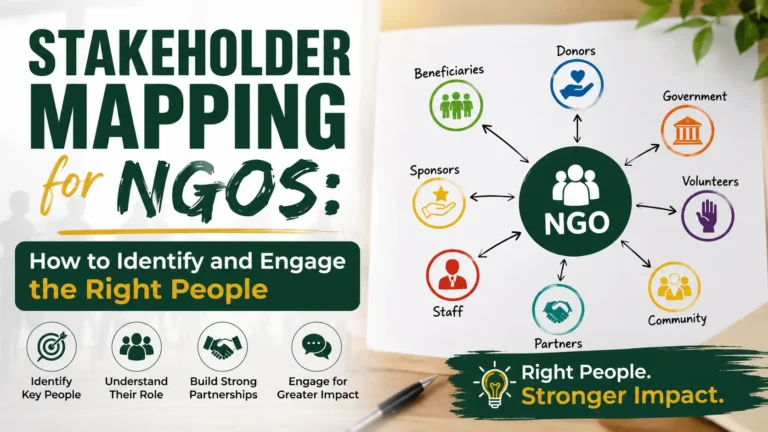
Stakeholder mapping is the process of identifying everyone who affects or is affected by your NGO’s work, then sorting them by how much influence and interest they have. It helps you decide who to inform, who to involve, and who to win over first.
If you run programs at an NGO, you already talk to a lot of people. Donors. Government officials. Community members. Volunteers. Local leaders. The problem is not a shortage of people to talk to. The problem is knowing who actually matters for a specific project, and how much time to spend on each one.
That is exactly what stakeholder mapping solves. It is a simple, visual way to organize the people connected to your work so your team stops guessing and starts engaging with purpose.
In this guide, we will walk through what stakeholder mapping means for NGOs, why it matters, who typically shows up on the map, and how to build one step by step.
What Is Stakeholder Mapping?
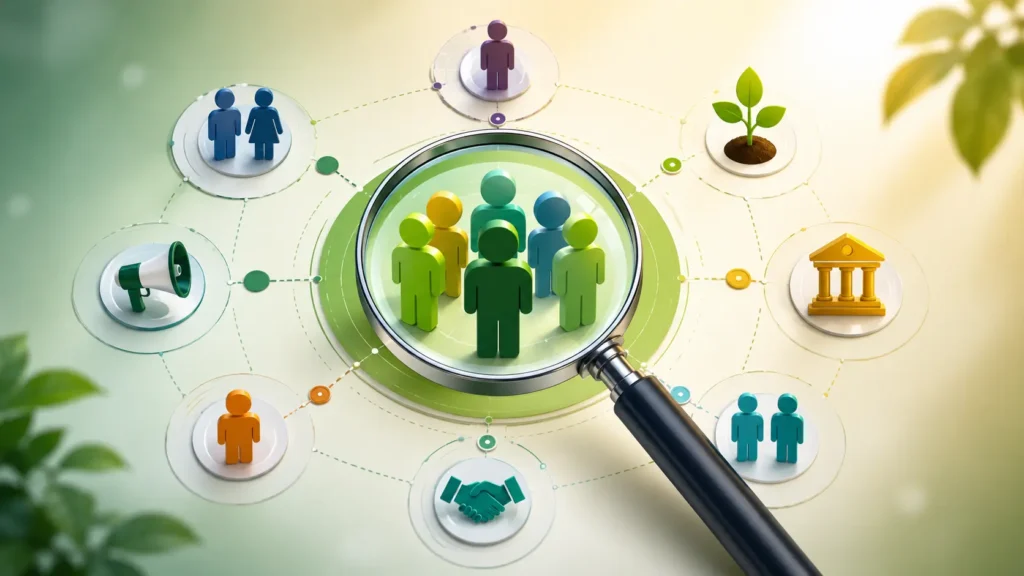
Stakeholder mapping is a planning tool that helps you list, sort, and prioritize the people, groups, and organizations connected to a project or cause. Each stakeholder is placed on a map based on two things: how much power or influence they hold, and how much interest they have in your work.
The result is a clear picture. Some names sit at the center, close to your project. Others sit further out, needing only occasional updates. This is what makes stakeholder mapping different from a plain contact list. A contact list tells you who exists. A stakeholder map tells you who matters, and why.
Why Stakeholder Mapping Matters for NGOs
NGOs work with limited staff, limited time, and limited budgets. Every hour spent on the wrong meeting is an hour taken away from the community you serve. Stakeholder mapping matters because it protects that scarce time.
- It prevents you from overlooking a decision-maker who could approve, fund, or block your project.
- It builds trust, because people feel informed and included at the right level, instead of ignored or overwhelmed.
- It reduces conflict, since you can spot opposing interests early and plan how to handle them.
- It strengthens grant applications and donor reports, which increasingly ask NGOs to show clear stakeholder engagement plans.
- It improves program design, because community voices are brought in before a project is finalized, not after something goes wrong.
Groups like the Stanford Social Innovation Review have written extensively about how weak stakeholder engagement is one of the quiet reasons well-funded programs still fail to deliver lasting change.
Who Are Your NGO’s Stakeholders?
Stakeholders are anyone who can affect, or is affected by, your organization’s decisions and activities. For most NGOs, they fall into two broad groups.
Internal Stakeholders
These are people inside your organization or closely tied to its daily operations.
- Board members and trustees
- Executive directors and program managers
- Staff and program officers
- Volunteers
- Existing members, if your NGO has a membership structure
External Stakeholders
These are people and groups outside your organization who still shape or feel the impact of your work.
- Donors and funding bodies, including individual donors, foundations, and government agencies
- Beneficiaries and the communities you serve
- Local government and regulatory bodies
- Partner NGOs and coalition members
- Media and press contacts
- Vendors, contractors, and service providers
- Community leaders, elders, and influencers
How to Identify the Right Stakeholders
Before you can map anyone, you need a full list. Here is a simple process to build it.
1. Start with your project goal
Write down exactly what the project is trying to achieve. This keeps your list relevant instead of endless.
2. Brainstorm with your team
Ask your program staff, field officers, and volunteers who they already talk to. Front-line staff often know names that never appear in a database.
3. Check past records
Look through old grant reports, meeting notes, and email threads. Previous partners and contacts are often still relevant.
4. Ask the community directly
Community members can point you toward local leaders, informal groups, and gatekeepers you would otherwise miss.
5. Group similar stakeholders together
Instead of listing 200 individual community members, group them as one stakeholder category, then note a few representative contacts within it.
How to Map Stakeholders: A Simple Framework
The most widely used tool is the power and interest grid. It is easy to draw on a whiteboard or a spreadsheet, and it works for organizations of any size.
Draw two lines that cross, forming four boxes. The vertical line represents power or influence, from low to high. The horizontal line represents interest in your project, from low to high. Then place each stakeholder in the box that fits them best.
- High power, high interest: Manage these closely. Involve them in planning and keep communication frequent.
- High power, low interest: Keep these satisfied. Give them clear, occasional updates without overloading them.
- Low power, high interest: Keep these informed. They can become strong advocates if engaged well.
- Low power, low interest: Monitor with minimum effort. A simple newsletter or annual update is usually enough.
This single grid answers the two questions every NGO team asks before a stakeholder meeting: who needs a seat at the table, and who just needs an email.
How to Engage Each Stakeholder Group
Mapping tells you who matters. Engagement is what you actually do about it. Here is how that usually plays out by group.
For high-power, high-interest stakeholders
Hold regular one-on-one meetings. Involve them in decisions early. Ask for their input before finalizing plans, not after.
For high-power, low-interest stakeholders
Send concise updates. Avoid asking for too much time. A short quarterly briefing usually works better than frequent long meetings.
For low-power, high-interest stakeholders
Bring them into workshops, feedback sessions, and community meetings. Their enthusiasm can turn into on-the-ground support.
For low-power, low-interest stakeholders
A newsletter, annual report, or social media update keeps them in the loop without draining staff time.
Common Mistakes NGOs Make in Stakeholder Mapping
- Treating the map as a one-time task instead of a living document
- Focusing only on donors while overlooking community members and local leaders
- Assuming influence never changes, when in reality power shifts after elections, leadership changes, or funding cycles
- Skipping the step of asking the community who they trust and listen to
- Building the map alone, instead of involving field staff who hold real relationships
How Often Should NGOs Update Their Stakeholder Map?
Update your stakeholder map at the start of every new project, and review it again at least once every six months. Also revisit it whenever there is a major change, such as new local leadership, a shift in government policy, or a new funding partner. A map built two years ago rarely reflects who actually holds influence today.
Tools You Can Use for Stakeholder Mapping
You do not need expensive software to get started. Many NGOs begin with a simple spreadsheet or a whiteboard grid, then move to more visual tools as their programs grow.
Getting Stakeholder Mapping Right Takes Practice
Stakeholder mapping sounds simple on paper, but doing it well takes practice, honest conversations, and a willingness to update the map as things change. Many NGOs find it helpful to have an outside perspective when building their first map, especially for large or politically sensitive projects.
If your team is planning a new program and wants a second pair of eyes on your stakeholder strategy, our team is happy to talk it through with you. A short conversation is often enough to spot gaps you might have missed on your own. Feel free to reach out or book a consultation whenever it suits you, no pressure, no obligation.
Frequently Asked Questions
What is stakeholder mapping in simple terms?
Stakeholder mapping is a way of listing everyone connected to your project and sorting them by how much power and interest they have, so you know who to engage closely and who just needs occasional updates.
Why is stakeholder mapping important for NGOs specifically?
NGOs work with limited budgets and staff, so stakeholder mapping helps them focus time on the people who can approve, fund, or influence a project, while still keeping the community’s voice at the center of decisions.
What are the main types of stakeholders in an NGO?
NGO stakeholders generally fall into two groups: internal stakeholders such as staff, board members, and volunteers, and external stakeholders such as donors, government bodies, partner organizations, and the communities being served.
What tool is most commonly used for stakeholder mapping?
The power and interest grid is the most common tool. It sorts stakeholders into four groups based on their level of influence and their level of interest in the project.
How often should a stakeholder map be updated?
A stakeholder map should be reviewed at the start of every new project and checked again at least twice a year, since power and interest levels shift with leadership changes, elections, and new funding partners.
Can small NGOs do stakeholder mapping without special software?
Yes. A spreadsheet or a whiteboard grid is enough to start. Software becomes useful later, once an NGO is managing many stakeholders across multiple projects.
Useful Links
- Stanford Social Innovation Review
- TechSoup
- NCVO (National Council for Voluntary Organisations)
- Bridgespan Group