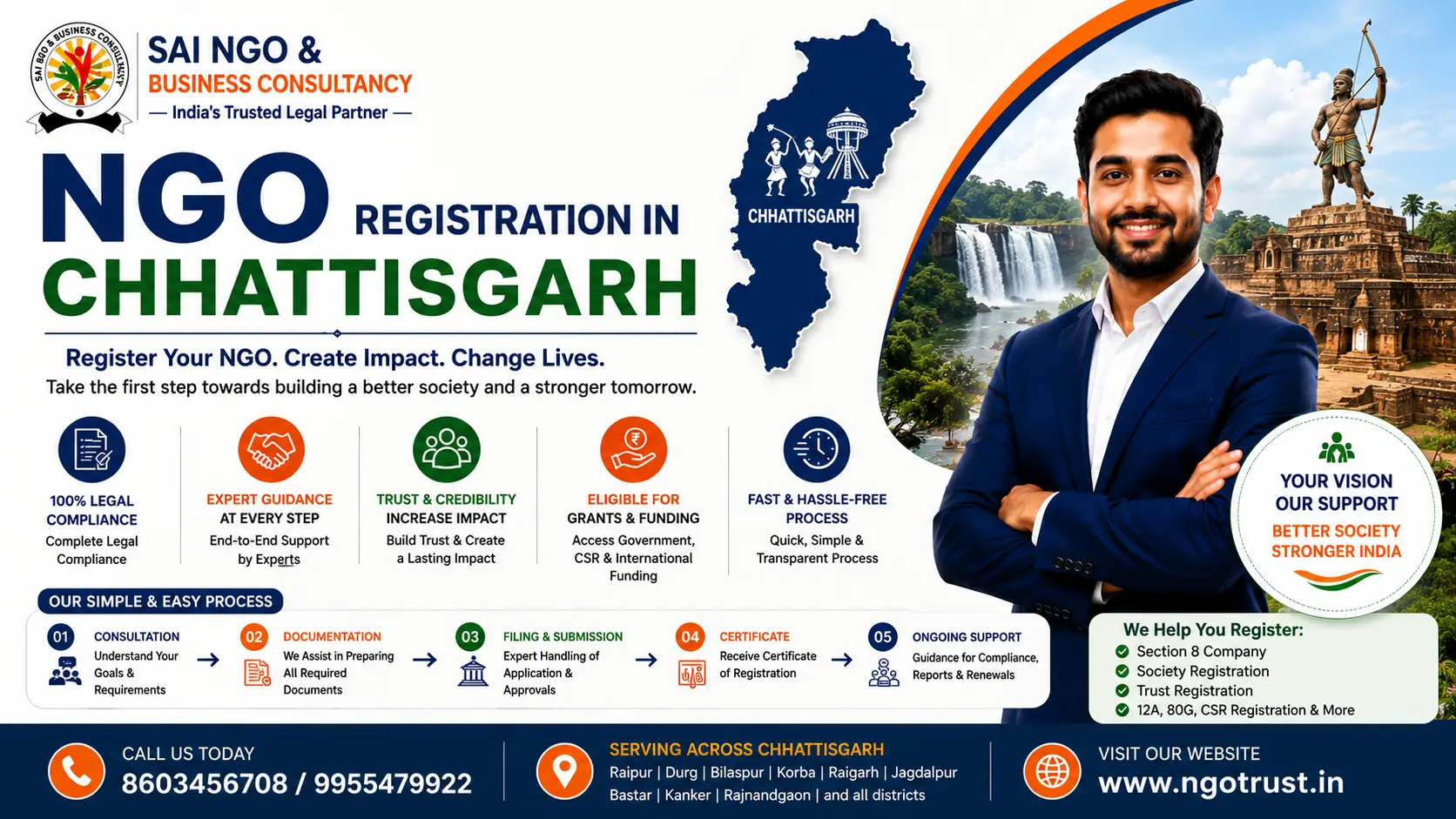
Starting a non-profit organisation is one of the most meaningful things a person can do. Whether you want to work on education, healthcare, women's empowerment, environmental protection, or rural development, the first practical step is always the same: getting your NGO registered.
If you are based in Chhattisgarh or want to operate in the state, this guide will walk you through everything, from choosing the right legal structure to submitting your documents, without the legal jargon.
Why Is NGO Registration in Chhattisgarh Important?
Many people begin their social work informally. That is admirable. But running an unregistered organisation has real limitations:
- Banks will not open an account in the organisation's name
- Donors cannot claim tax exemptions on their contributions
- You cannot apply for government or CSR (Corporate Social Responsibility) grants
- The organisation has no legal standing to sign contracts or hold property
- Credibility with the public and partner organisations is much lower
Registration solves all of these problems. It gives your NGO a legal identity, builds public trust, and opens doors to funding that an informal group simply cannot access.
Who Needs to Register an NGO in Chhattisgarh?
You need to go through the NGO registration process in Chhattisgarh if you are:
- A group of individuals working toward a charitable, educational, religious, or social cause
- A professional setting up a non-profit to receive grants or CSR funds
- An existing informal welfare group wanting to formalise operations
- A person who wants 80G or 12A income tax benefits for donors
There is no minimum age to promote an NGO (though directors/trustees must be adults), and there is no residency restriction. People from outside Chhattisgarh can also register an NGO in the state if they plan to operate there.
What Are the 3 Types of NGO Registration in Chhattisgarh?
There are three recognised legal structures for NGO registration in India, all valid in Chhattisgarh:
1. Society Registration (Under Societies Registration Act, 1860)
This is the most common form. A society needs at least seven members and is governed by a Memorandum of Association (MoA) and rules and regulations. It is registered with the Registrar of Societies, Chhattisgarh.
- Best for: Community welfare, cultural, educational, and charitable organisations
- Governing body: Registrar of Societies, Chhattisgarh
- Renewal: Annual filing required
2. Trust Registration (Under Indian Trusts Act, 1882)
A trust is created when a settlor hands over property or assets to trustees for the benefit of beneficiaries. It requires a minimum of two trustees and is registered with the Sub-Registrar of the district.
- Best for: Philanthropy, religious activities, and family-based non-profits
- Governing body: Sub-Registrar of the district
- Renewal: Generally no mandatory annual renewal
3. Section 8 Company (Under Companies Act, 2013)
A Section 8 company is a non-profit registered as a company with the Ministry of Corporate Affairs (MCA). It has the highest credibility, is governed by MCA rules, and is preferred for larger NGOs with professional governance.
- Best for: Larger NGOs, foundations, and organisations seeking foreign funding (FCRA)
- Governing body: Ministry of Corporate Affairs (MCA)
- Renewal: Annual ROC compliance required
Step-by-Step NGO Registration Process in Chhattisgarh
| Step | Process | Details |
|---|
| Step 1 | Decide the Legal Structure |
Choose between Society, Trust, or
Section 8 Company based on your purpose, scale, and governance preference.
For most grassroots organisations in Chhattisgarh, Society registration is the most practical starting point. |
| Step 2 | Choose a Unique Name |
Pick a name that reflects your mission. Make sure it is not identical or confusingly similar
to an already registered NGO. For Section 8 companies, you must run a name availability check on the
MCA portal. |
| Step 3 | Draft the Foundation Documents |
These are the core legal documents:- For Society: Memorandum of Association (MoA) and Rules & Regulations
- For Trust: Trust Deed
- For Section 8 Company: Memorandum of Association (MoA) and Articles of Association (AoA)
These documents define your NGO's objectives, governance structure,
membership rules, and operational procedures. Getting them right the first time
saves a lot of back-and-forth later. |
| Step 4 | Gather Required Documents |
The standard documents needed for NGO registration in Chhattisgarh include:- PAN Card and Aadhaar Card of all members / trustees / directors
- Passport-size photographs of all members
- Proof of registered office address (rent agreement or ownership deed + utility bill)
- No-Objection Certificate (NOC) from the property owner if office is rented
- Draft MoA, Trust Deed, or MoA + AoA as applicable
- List of governing body members with addresses and occupations
|
| Step 5 | Submit the Application | -
Society: Submit to the Registrar of Societies, Chhattisgarh
(located in Raipur) along with the prescribed fee.
-
Trust: Register the Trust Deed at the Sub-Registrar's office
in the relevant district with stamp duty.
-
Section 8 Company: File online through the
MCA portal
using forms SPICe+ and INC-12.
|
| Step 6 | Obtain the Registration Certificate |
Once the authorities verify your documents and are satisfied,
they issue a registration certificate.- Societies: Typically takes 15 to 30 working days
- Trusts: Can often be registered on the same day at the Sub-Registrar's office
- Section 8 Companies: Usually takes 20 to 45 working days depending on MCA processing
|
| Step 7 | Apply for 12A and 80G Registration |
After NGO registration, you should apply for:-
12A Registration: Exempts the NGO's own income from income tax.
-
80G Registration: Allows donors to claim 50% deduction on donations made to your NGO.
This is a huge motivator for individual and corporate donors.
Both are filed online through the
Income Tax portal
.
Having 12A and 80G significantly improves your NGO's ability to attract funding. |
What Is the Cost of NGO Registration in Chhattisgarh?
Fees vary by structure:
- Society registration: Government fees are nominal (typically Rs. 500 to Rs. 2,000 depending on membership size). Professional fees vary by service provider.
- Trust registration: Stamp duty is calculated on the value of the trust property. For a basic charitable trust with minimal assets, this can be very low.
- Section 8 Company: No government fee for registration (zero fee for companies with share capital less than Rs. 15 lakh under the simplified SPICe+ process). Professional fees apply.
If you choose to work with a legal professional or registration service, total costs including professional fees generally range from Rs. 5,000 to Rs. 25,000 depending on the structure and complexity.
How Long Does NGO Registration Take in Chhattisgarh?
Approximate timelines:
- Society: 15 to 30 working days after document submission
- Trust: 1 to 3 days (executed at Sub-Registrar's office)
- Section 8 Company: 20 to 45 working days (MCA processing)
Delays usually happen when documents are incomplete or the chosen name is already taken. Getting your paperwork right before submission makes a big difference.
FCRA Registration: For NGOs Receiving Foreign Funds
If your NGO plans to receive donations or grants from foreign sources, you will also need FCRA (Foreign Contribution Regulation Act) registration from the Ministry of Home Affairs. This is a separate, additional registration that can only be applied for after your NGO has been operational for at least 3 years. You can apply through the FCRA online portal.
For new NGOs expecting foreign funding, a Prior Permission under FCRA is available as an alternative during the first three years.
Common Mistakes to Avoid During NGO Registration in Chhattisgarh
- Choosing a name that is too generic or already registered
- Poorly drafted MoA or Trust Deed that does not clearly state the charitable objects
- Missing or mismatched documents (ID proof vs. address proof)
- Not mentioning the registered office address correctly
- Delaying 12A and 80G applications after registration
- Not maintaining annual compliance filings after registration
After Registration: What Are the Compliance Requirements?
Registration is just the beginning. Once your NGO is registered in Chhattisgarh, you will need to:
- File annual returns with the Registrar of Societies or ROC (for Section 8)
- Maintain proper accounts and get them audited every year
- Renew 12A and 80G registrations as required (CBDT revised rules apply)
- File income tax returns every year
- Submit FCRA annual returns if you receive foreign funds
Staying on top of compliance keeps your NGO's legal status active and donors confident.
Should You Use a Professional Service for NGO Registration in Chhattisgarh?
You can do everything yourself, especially if you have some knowledge of legal documents and government portals. That said, many first-time NGO founders find the process overwhelming, particularly drafting the MoA or Trust Deed correctly and navigating the MCA portal.
A qualified CA, legal professional, or NGO registration consultant can handle the paperwork, follow up with authorities, and flag any errors before they become problems. This is not a requirement, but it does reduce stress and the risk of rejection.
If you are unsure where to start or which structure suits your goals best, even a single consultation with a professional can save you significant time and money down the road.
Useful Resources for NGO Registration in Chhattisgarh
Here are the official portals you will use during the NGO registration process:
Ready to Register Your NGO in Chhattisgarh?
The registration process is straightforward when you know what to do. If you have questions about which structure suits your goals, what documents to prepare, or how to apply for 12A and 80G, speaking with someone who has done this before can save you a lot of time.
Feel free to reach out for a no-pressure consultation. We are happy to help you understand your options and point you in the right direction, whether you decide to work with us or handle it on your own.
Useful Links