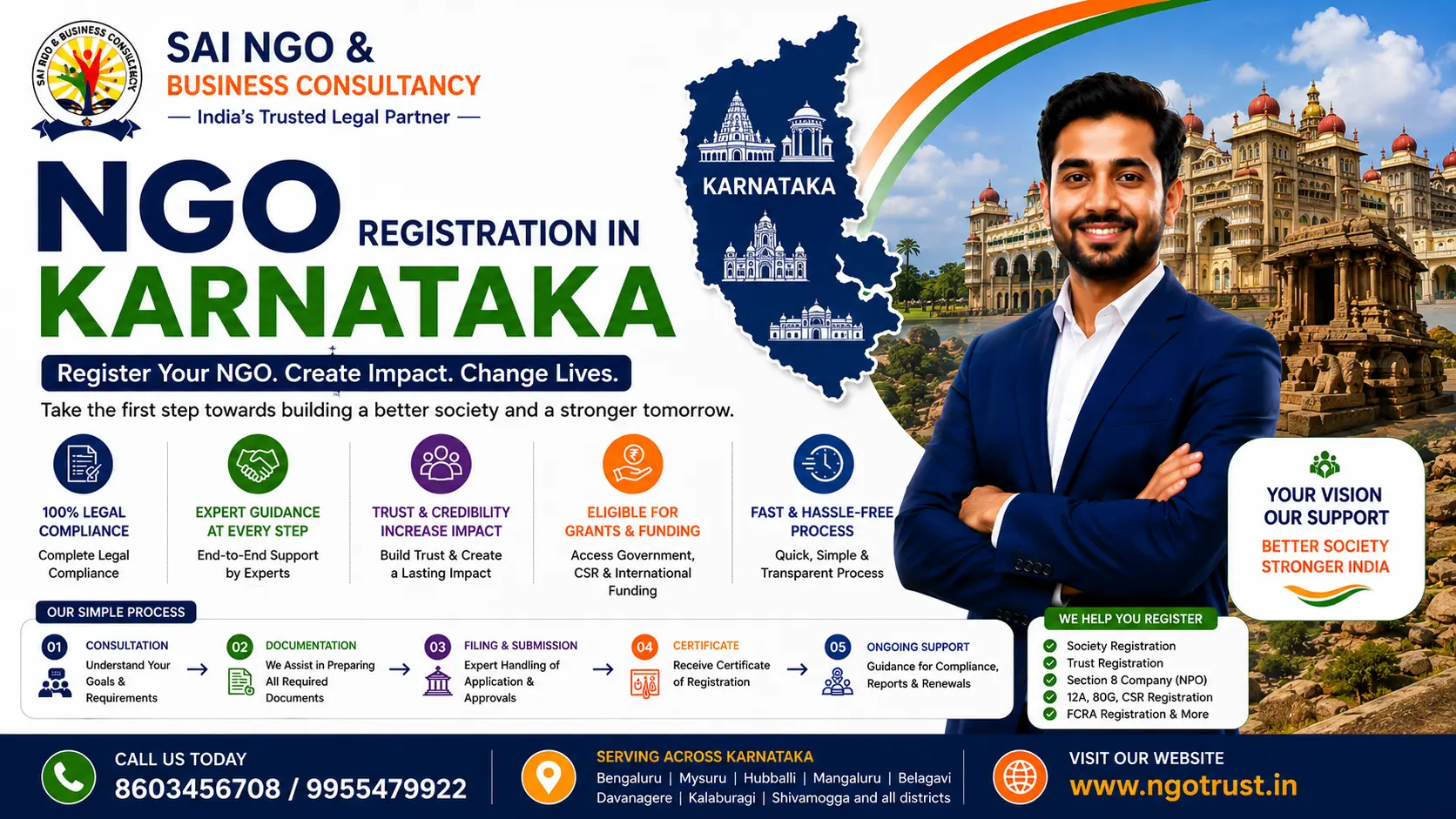
Starting a non-profit is one of the most meaningful things you can do. Whether you want to run a school in a village, support women entrepreneurs, protect wildlife, or feed the homeless, the mission matters. But without proper NGO registration in Karnataka, even the most well-intentioned work can run into legal trouble, lose donor trust, or miss out on government funding.
This guide walks you through everything you need to know about how to register an NGO in Karnataka, including which structure suits you, the documents you need, the step-by-step process, the costs involved, and the compliance obligations that come after registration.
Why Does NGO Registration in Karnataka Actually Matter?
A lot of social work happens informally in India, and that is admirable. But when you register your NGO, several things change for the better.
- Your organisation becomes a separate legal entity, which protects founders from personal liability.
- Donors, especially corporate CSR departments and international foundations, prefer or require registered NGOs.
- You become eligible for government grants, FCRA approval for foreign contributions, and tax exemptions under Sections 12A and 80G of the Income Tax Act.
- Your NGO can open a bank account, own property, and enter into contracts in its own name.
- It builds credibility and long-term trust with the community you serve.
Three Ways to Register an NGO in Karnataka
There is no single NGO registration form or single law in India. You pick one of three legal structures based on your purpose, scale, and governance preferences.
1. Trust Registration in Karnataka
A Public Charitable Trust is the oldest and most straightforward structure. It is governed by the Indian Trusts Act, 1882. In Karnataka, trusts are registered with the Sub-Registrar of the district where the trust operates.
Best suited for: Charitable activities, religious organisations, educational and healthcare NGOs.
Minimum required: 2 trustees. No maximum limit.
Key document: Trust Deed, drafted and registered on stamp paper.
2. Society Registration in Karnataka
Societies are registered under the Karnataka Societies Registration Act, 1960 with the Registrar of Societies (District Registrar). This structure suits groups of people working toward a common goal, like education, arts, sports, or community welfare.
Minimum required: 7 members for state-level registration; 8 or more states require at least 8 members for a national-level society.
Key document: Memorandum of Association (MoA) and Rules and Regulations.
Many NGOs prefer this structure because it is democratic in nature, with a governing body elected by members.
3. Section 8 Company Registration in Karnataka
A Section 8 Company is registered under the Companies Act, 2013 with the Ministry of Corporate Affairs (MCA). It is the most structured and credible format, preferred by larger NGOs and those working with international partners or big corporate CSR donors.
Minimum required: 2 directors (Private) or 3 directors (Public). No minimum share capital.
Governing body: Registrar of Companies (RoC), Ministry of Corporate Affairs.
Section 8 companies enjoy higher credibility, stricter governance, and are exempt from using 'Limited' or 'Pvt Ltd' in their name.
Step-by-Step: How to Register an NGO in Karnataka
Registering a Society in Karnataka (Step-by-Step)
- Choose a unique name for your society and check availability.
- Draft the Memorandum of Association (MoA) with the name, objectives, address, and member details.
- Prepare the Rules and Regulations document governing meetings, elections, and finances.
- Collect signatures from all founding members (minimum 7) with their address proof and ID proof.
- Submit the application along with required documents to the Registrar of Societies in your district.
- Pay the prescribed registration fee.
- On verification and approval, the Registrar issues the Certificate of Registration.
Registering a Trust in Karnataka (Step-by-Step)
- Decide on the name of the trust and its objectives.
- Draft a Trust Deed with details of the settlor (founder), trustees, beneficiaries, and trust property.
- Print the Trust Deed on non-judicial stamp paper of appropriate value.
- Get the Trust Deed signed by the settlor and at least two witnesses.
- Visit the Sub-Registrar Office in the concerned district with original ID and address proof.
- Pay the stamp duty and registration fee.
- Collect the registered Trust Deed, which serves as proof of registration.
Registering a Section 8 Company in Karnataka (Step-by-Step)
- Obtain Digital Signature Certificates (DSC) for all proposed directors.
- Apply for Director Identification Numbers (DIN) through the MCA portal.
- File an application for name reservation using the RUN (Reserve Unique Name) form on the MCA portal.
- Draft the Memorandum of Association (MoA) and Articles of Association (AoA).
- File the SPICe+ (Simplified Proforma for Incorporating Company Electronically Plus) form on the MCA portal along with required documents.
- Pay the government fees online.
- On approval, the Registrar of Companies issues the Certificate of Incorporation.
Documents Required for NGO Registration in Karnataka
While the exact list varies slightly by structure, these are the core documents you will need across most NGO registrations in Karnataka:
- Identity proof of all founders/trustees/directors (Aadhaar, PAN, Passport)
- Address proof of all founders/trustees/directors
- Proof of registered office address (rent agreement + utility bill, or ownership proof)
- Photographs of all members
- PAN card of each member
- Drafted and signed MoA / Trust Deed / AoA (as applicable)
- Rules and Regulations document (for societies)
- NOC from property owner if the registered address is rented
- Stamp paper of requisite value (for trusts and societies)
How Much Does NGO Registration in Karnataka Cost?
Costs vary depending on the structure you choose and whether you hire a professional to help with the process.
- Trust Registration: Government fees are relatively low (stamp duty + Sub-Registrar fee). Professional fees typically range from Rs. 5,000 to Rs. 15,000.
- Society Registration: Government fee is generally Rs. 500 to Rs. 2,000 depending on the district. Professional fees range from Rs. 5,000 to Rs. 20,000.
- Section 8 Company: MCA filing fees are modest for companies with no share capital. However, the process is more complex; professional fees typically range from Rs. 10,000 to Rs. 30,000.
Keep in mind that these are indicative ranges. Costs can be higher in urban districts like Bengaluru and can vary based on the complexity of your documents and legal requirements.
What Happens After NGO Registration in Karnataka?
Getting registered is the first step, not the last. After NGO registration in Karnataka, you will need to take care of several post-registration steps:
Tax Exemption Registration (12A and 80G)
Apply to the Income Tax Department for registration under Section 12A (to make the NGO's income tax-exempt) and Section 80G (to allow donors to claim deductions on their donations). Both registrations are now processed through the Income Tax portal and are valid for five years.
FCRA Registration for Foreign Funding
If you plan to receive donations from foreign individuals or organisations, you need to register under the Foreign Contribution (Regulation) Act (FCRA) with the Ministry of Home Affairs. FCRA registration requires the NGO to be at least three years old and have spent at least Rs. 15 lakh on its core activities in those three years.
Annual Compliance Obligations
- File annual reports with the Registrar of Societies or RoC, depending on your structure.
- Maintain audited financial statements every year.
- File income tax returns annually, even if income is below the taxable limit.
- Renew 12A and 80G registrations every five years.
- Comply with FCRA annual return filing if you receive foreign funds.
Common Mistakes People Make During NGO Registration in Karnataka
- Choosing the wrong structure: A trust is easy to set up but harder to change later. Pick the right fit from day one.
- Vague objectives in the MoA or Trust Deed: Ambiguous language can cause rejection or restrict future activities.
- Incomplete or mismatched documents: Small errors in names or addresses across documents can delay the process significantly.
- Ignoring post-registration compliance: Many NGOs register and then miss annual filings, which can lead to cancellation of status.
- Not applying for 12A and 80G promptly: Delaying these applications means your donors cannot claim deductions and your income may be taxable.
Frequently Asked Questions About NGO Registration in Karnataka
How long does NGO registration in Karnataka take?
It depends on the structure. Trust registration is usually the fastest and can be completed in 1 to 2 weeks. Society registration typically takes 3 to 6 weeks. Section 8 Company registration can take 4 to 8 weeks, depending on MCA processing times and the accuracy of your documents.
Which is better: Trust, Society, or Section 8 Company for an NGO in Karnataka?
It depends on your goals. If you want a simple structure with fewer compliance requirements, a Trust or Society works well. If you plan to scale, attract large donors, or work internationally, a Section 8 Company offers higher credibility and structured governance.
Can a single person register an NGO in Karnataka?
No. All three structures require a minimum number of people: 2 trustees for a Trust, 7 members for a Society, and 2 directors for a private Section 8 Company.
Is NGO registration in Karnataka mandatory to receive donations?
Technically, you can receive donations without registration, but you will not be eligible for tax exemptions (12A/80G), FCRA-regulated foreign funds, or many government grant schemes. Registered NGOs also gain far more trust from donors.
What is the difference between 12A and 80G registration?
Section 12A makes the NGO's income tax-exempt, meaning the organisation does not pay income tax on donations received and used for its objectives. Section 80G benefits the donor by allowing them to claim a deduction on the amount donated to your NGO while filing their own income tax return.
Can an NGO registered in Karnataka operate across India?
Yes. Once registered, an NGO can operate anywhere in India. However, if you register as a Society at the state level, you may need to update your registration or register separately in other states depending on the scope of your activities.
What is Darpan registration and is it needed?
Darpan is an online portal maintained by NITI Aayog for NGOs. Registering on the NGO Darpan portal is not mandatory for basic registration but is required if you wish to apply for government grants or central government schemes. It is free and relatively simple to complete.
Need Help with NGO Registration in Karnataka?
Registering an NGO involves more than filling out forms. The structure you choose, the language in your MoA, the documents you attach, and the timelines you follow all affect whether your registration goes through smoothly or hits a wall.
If you are setting up your NGO for the first time, or if you have tried the process before and run into problems, having an experienced professional guide you through it can save you weeks of back-and-forth and prevent errors that are costly to fix later.
Our team has helped hundreds of non-profits, trusts, and social enterprises complete their NGO registration in Karnataka correctly and on time. We also help with 12A, 80G, FCRA, Darpan registration, and ongoing compliance.
If you have any questions or want to get a quick sense of which structure fits your mission, feel free to reach out for a no-obligation consultation. We are happy to help you get this right from the start.
Useful Links
Disclaimer: This article is for informational purposes only and does not constitute legal advice. Laws and procedures may change; always verify current requirements with the relevant government authority or a qualified legal professional before proceeding.