You have a cause worth fighting for. A community you want to serve. An idea that can genuinely change lives in Goa. But before you can raise funds, apply for government grants, or hire a team, you need to get one thing right: legal registration. This guide walks you through everything you need to know about NGO registration in Goa, in plain, simple language.
Whether you are a first-time founder or someone expanding an existing initiative, this post will help you understand the types of NGOs, the correct registration process, the documents you will need, and the common mistakes people make along the way.
What Is NGO Registration in Goa — and Why Does It Matter?
Registering your NGO is not just a legal formality. It is the foundation that gives your organization credibility, legal identity, and the ability to accept donations, apply for grants, and operate transparently.
Without proper registration, your NGO cannot:
- Open a bank account in the organization's name
- Receive tax-exempt donations under Section 80G
- Apply for CSR funds from corporates
- Access government schemes and funding from bodies like the Ministry of Social Justice
- Enter into contracts or own property legally
In short, a registered NGO is a credible NGO. And in Goa's growing civil society space, credibility opens doors.
Who Needs to Register an NGO in Goa?
You should consider NGO registration in Goa if you are:
- Starting a charitable organization focused on education, health, environment, or social welfare
- Setting up a community welfare group or residents' association with formal activities
- Launching a foundation or trust in memory of a loved one
- Creating a professional body or cultural society
- Expanding a voluntary initiative into a structured, fundable organization
If any of these describe you, read on.
3 Types of NGO Registration in Goa: Which One Is Right for You?
This is the most important decision you will make in the entire registration process. Each structure comes with different rules, compliance requirements, and governance patterns.
1. Trust Registration Under the Goa Public Trusts Act
Best for: Family-run charitable initiatives, smaller NGOs, personal foundations.
A trust is the simplest and oldest form of NGO structure in India. In Goa, public charitable trusts are governed by the Goa Public Trusts Act and registered with the office of the Charity Commissioner.
A trust needs at least two trustees (a settlor and a trustee), a Trust Deed, and a corpus donation. The deed defines the purpose, beneficiaries, and rules of the trust.
2. Society Registration Under the Societies Registration Act, 1860
Best for: Membership-based organizations, cultural bodies, educational societies, professional associations.
Societies are registered under the Societies Registration Act, 1860 with the Registrar of Societies in Goa. A minimum of 7 members is required, along with a Memorandum of Association and Rules and Regulations document.
Societies work well for organizations that want democratic governance where members vote on decisions.
3. Section 8 Company Under the Companies Act, 2013
Best for: Large NGOs, professional nonprofits, organizations seeking CSR funds from large corporates.
A Section 8 Company is the most structured and credible form of an NGO. It is registered with the Ministry of Corporate Affairs (MCA) and requires at least 2 directors and 2 shareholders (can be the same persons).
It offers limited liability protection, higher corporate credibility, and is preferred by large donors and grant-makers. However, it also carries the highest compliance burden.
Quick Comparison: Trust vs Society vs Section 8 Company
| Structure | Minimum Members | Authority | Core Document | Compliance |
|---|
| Trust | 2 trustees minimum | Goa Charity Commissioner | Simple deed | Low compliance |
| Society | 7 members minimum | Registrar of Societies, Goa | MOA + Rules | Moderate compliance |
| Section 8 Company | 2 directors minimum | Ministry of Corporate Affairs | MOA + AOA | High compliance |
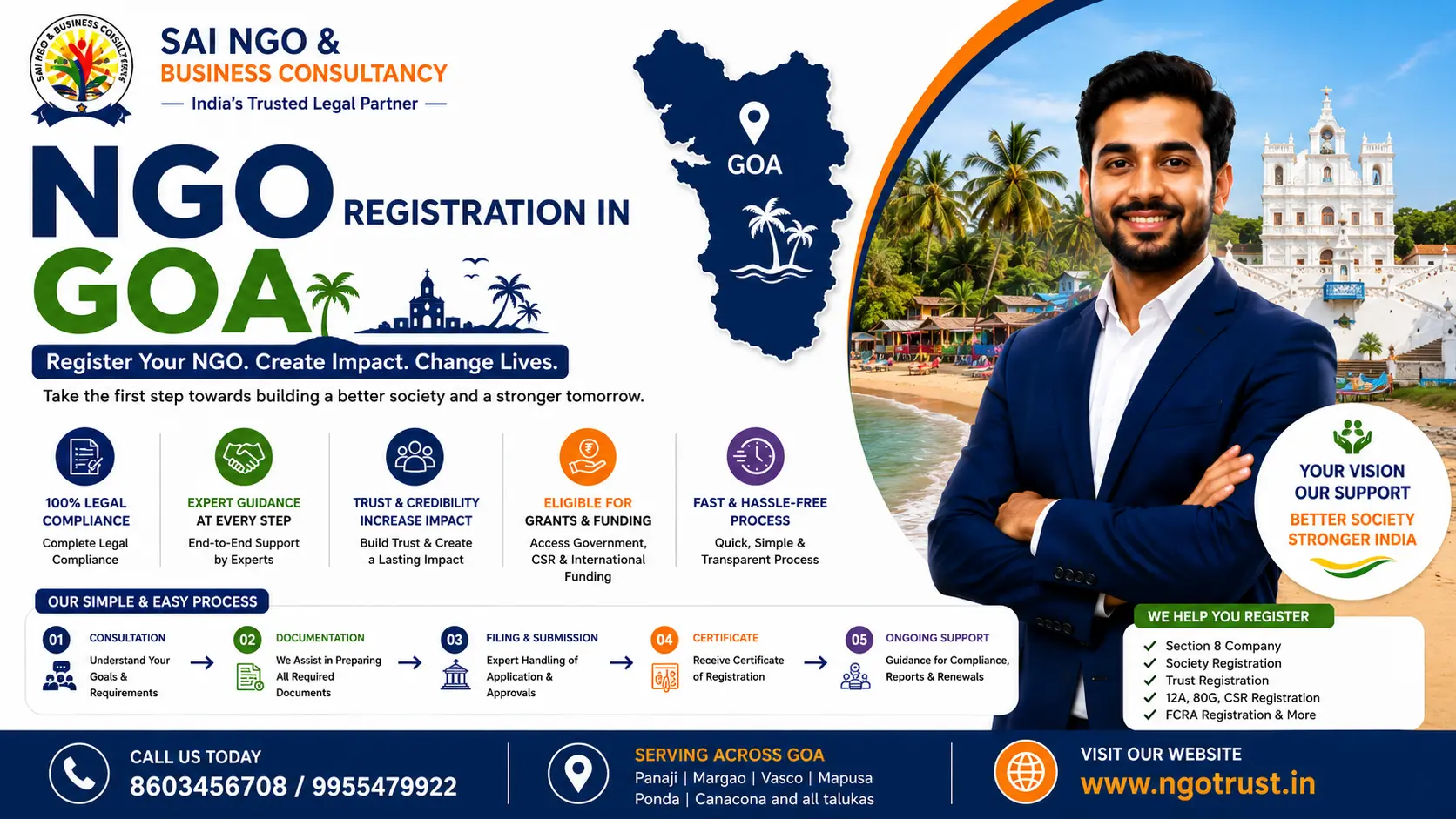
Step-by-Step Process for NGO Registration in Goa
Step 1: Choose Your NGO Structure
Decide between a Trust, Society, or Section 8 Company based on your organization's size, goals, and governance preference.
Step 2: Choose a Name
Pick a unique name that reflects your mission. For Section 8 Companies, check name availability on the MCA portal. For Trusts and Societies, confirm the name is not already taken in Goa.
Step 3: Draft Your Core Documents
Every NGO type needs a founding document:
- Trust: Trust Deed
- Society: Memorandum of Association (MOA) and Rules and Regulations
- Section 8 Company: MOA and Articles of Association (AOA)
These documents define your purpose, governance, and operations. Poorly drafted documents are the single biggest reason NGO registrations face delays or rejections.
Step 4: Prepare Your Document Package
You will typically need:
- Identity proof (Aadhaar, PAN) of all founders/members/trustees
- Address proof of all founders
- Passport-size photographs
- Registered office address proof (rent agreement or ownership documents)
- NOC from the property owner if the office is rented
- PAN card of the organization (applied after registration)
- Affidavits and declarations as required by the registering authority
Step 5: Submit the Application
For Trusts, submit to the office of the Charity Commissioner, Goa in Panaji. For Societies, apply to the Registrar of Societies. For Section 8 Companies, file online through the MCA Portal (mca.gov.in).
Step 6: Pay the Registration Fees
Fees vary by structure and are updated periodically. Trusts and Societies typically have nominal state fees. Section 8 Company registration has central government fees charged on authorized capital.
Step 7: Receive Your Registration Certificate
Once approved, you receive a registration certificate. This is your NGO's legal birth certificate. Keep multiple certified copies safe.
Post-Registration: What Comes Next?
Registration is just the beginning. After your NGO is registered, you will need to:
- Apply for PAN — a must before opening a bank account or filing taxes
- Open a bank account in the name of the NGO
- Register for 12A — for income tax exemption on the NGO's income
- Register for 80G — so donors can claim deductions on their contributions
- Register on DARPAN — the NGO registration portal of NITI Aayog (required for government grants)
- FCRA Registration — required if you plan to receive foreign contributions (from outside India)
- File annual returns — Societies and Section 8 Companies must file annual reports with their respective registering authorities
You can register on NITI Aayog's NGO DARPAN Portal and apply for FCRA registration through the Ministry of Home Affairs FCRA portal.
Common Mistakes to Avoid During NGO Registration in Goa
- Choosing the wrong structure for your organization size and goals
- Drafting a vague or incomplete Trust Deed or MOA
- Using a registered office address without a proper NOC from the owner
- Skipping 12A and 80G registration after getting the certificate (this delays fundraising significantly)
- Not registering on DARPAN, which makes the NGO ineligible for most government schemes
- Ignoring annual compliance filings, which can result in cancellation of registration
- Assuming that NGO registration automatically grants tax exemption (it does not — 12A does)
Useful Government Resources for NGO Registration in Goa
Here are the official resources you should bookmark:
What is the cost of NGO registration in Goa?
Costs vary. Trust and Society registrations have relatively low state government fees (often a few hundred to a few thousand rupees). Section 8 Company registration costs depend on authorized capital, plus professional fees if you engage a consultant. Budget separately for drafting fees, notarization, and stamp duty on documents.
Is 12A registration mandatory for an NGO?
It is not mandatory, but it is practically essential. Without 12A registration, the income of your NGO will be taxable. Most grant-makers, CSR donors, and government bodies expect a 12A certificate before releasing funds.
Can an NGO registered in Goa receive international funds?
Yes, but only after obtaining FCRA (Foreign Contribution Regulation Act) registration from the Ministry of Home Affairs. This is a separate registration distinct from your NGO's primary registration.
Ready to Register Your NGO in Goa?
Getting your NGO registered the right way can make the difference between an organization that struggles with legal hurdles and one that focuses entirely on its mission.
The process has several moving parts — choosing the right structure, drafting legally sound documents, coordinating with the right authority, and following up on post-registration compliance. It is entirely doable, but it does require attention to detail.
If you are feeling unsure about which structure suits your situation, or if you want to make sure your documents are properly drafted the first time, it may be worth speaking with a professional who handles NGO registrations regularly.
Want Help with NGO Registration in Goa?
A short consultation can save you weeks of back-and-forth with government authorities.
You can reach out to us to discuss your NGO's goals, and we will help you figure out the right path forward — no pressure, just clarity.
Useful Links