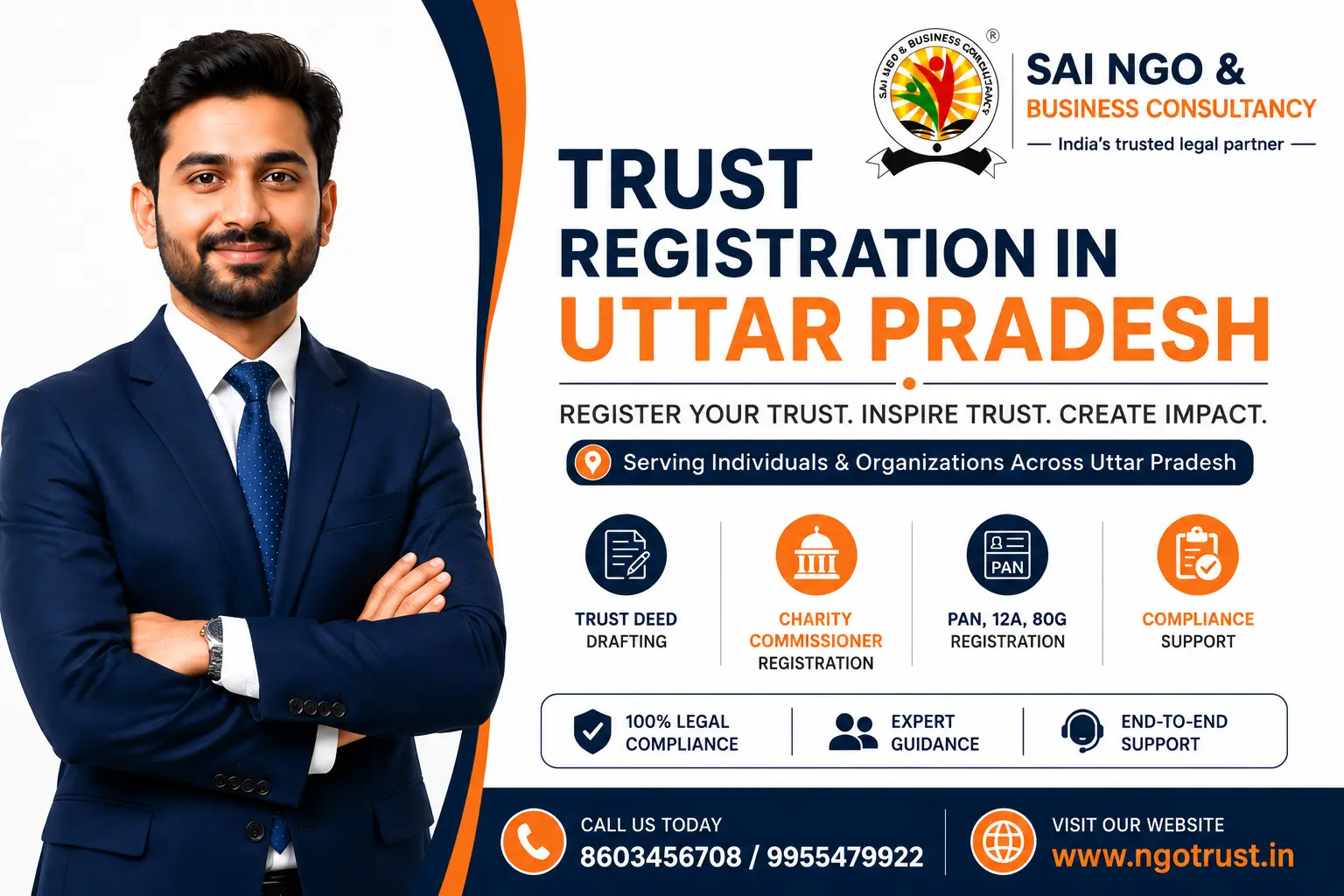
If you want to set up a charitable organisation, a religious body, or a public welfare institution in Uttar Pradesh, trust registration is one of the most important legal steps you will take.
In UP, trusts are primarily governed under the Indian Trusts Act, 1882 (for private trusts) and specific state-level frameworks under the UP Societies Registration Act and other regulations for public charitable trusts. Once your trust is officially registered, it becomes a recognised legal entity. That means it can open bank accounts, accept donations, apply for tax exemptions under Section 12A and 80G of the Income Tax Act, and work transparently with the government and donors.
Without registration, a trust remains informal. It cannot receive foreign contributions (under FCRA), apply for government grants, or get 80G tax exemption for its donors. Simply put, an unregistered trust has very limited reach.
Who Needs to Register a Trust in UP?
Trust registration in Uttar Pradesh is relevant for:
- Individuals or groups setting up a charitable trust for education, healthcare, or social welfare
- Religious organisations wanting formal legal recognition
- Professionals or families creating a private family trust
- NGOs and non-profit founders looking to operate transparently
- Organisations seeking government funding or foreign contributions
Key Benefits of Registering a Trust in Uttar Pradesh
Many people ask whether trust registration is truly worth the effort. The answer is a clear yes. Here is why:
- Legal Identity: A registered trust has a legal identity separate from its founders. It can sue and be sued, enter into contracts, and hold property in its own name.
- Tax Benefits: Registered charitable trusts can apply for 12A registration (income tax exemption) and 80G certification (tax deduction for donors), making it much easier to raise funds.
- Credibility and Trust: Donors, government bodies, and the public are far more likely to support a registered organisation. Registration signals accountability.
- Bank Account and Grants: A registered trust can open a dedicated bank account, apply for CSR funding, and receive government grants that are unavailable to unregistered entities.
- FCRA Eligibility: If you plan to receive foreign donations, trust registration is a prerequisite for applying under the Foreign Contribution (Regulation) Act.
- Property Ownership: The trust can legally hold immovable property, ensuring assets are protected and managed according to the trust deed.
- Continuity: Unlike a sole proprietorship, a trust does not dissolve when a trustee leaves or passes away. Its operations continue uninterrupted.
How to Register a Trust in Uttar Pradesh: Step-by-Step
The process for trust registration in UP is straightforward when you know what to expect. Here is a practical breakdown:
| Step | Title | Description & Details |
|---|
| Step 1 | Decide the Type of Trust | First, clarify whether you are forming a private trust (for the benefit of specific individuals, like a family trust) or a public charitable trust (for the general public, such as an educational or medical trust). This choice affects the governing law and the registration authority. |
| Step 2 | Draft the Trust Deed | The trust deed is the most important document in the entire process. It is a legal document that sets out the name of the trust, its objectives, the names and addresses of the trustees, the settler (author) of the trust, the beneficiaries, and the rules governing how the trust will operate.
A well-drafted trust deed should include:- Name of the trust
- Registered address in Uttar Pradesh
- Objects and purpose of the trust
- Details of the settler (author) and trustees (minimum 2)
- Powers and duties of trustees
- Rules for adding or removing trustees
- Details of the initial trust property or corpus
|
| Step 3 | Get the Trust Deed Stamped | The trust deed must be printed on non-judicial stamp paper of the appropriate value as prescribed by UP stamp duty rules. The stamp duty amount varies depending on the value of the trust property. This step is mandatory before registration. |
| Step 4 | Submit Documents to the Sub-Registrar's Office | For most public charitable trusts in Uttar Pradesh, the trust deed is registered at the office of the Sub-Registrar (also called the Sub-Divisional Magistrate or SDM in some cases) in the district where the trust's registered address is located.
Documents typically required for trust registration in UP:- Original trust deed on stamp paper (with two photocopies)
- Passport-sized photographs of all trustees
- PAN card copies of all trustees
- Address proof of all trustees (Aadhaar, voter ID, or passport)
- Address proof for the trust's registered office (utility bill, rent agreement, or NOC from property owner)
- Identity proof of the settler (author) of the trust
- Covering letter or application form (varies by district)
|
| Step 5 | Pay Registration Fees | At the Sub-Registrar's office, you will need to pay the applicable registration fees. The fees are relatively modest and depend on the value of the property mentioned in the deed. After payment, the deed is entered into the register of the Sub-Registrar's office. |
| Step 6 | Obtain the Registration Certificate | Once verified, the Sub-Registrar issues a registered copy of the trust deed with an official stamp and registration number. This is your trust's primary legal document. Keep it safe. |
| Step 7 | Apply for PAN and Open a Bank Account | After registration, apply for a PAN in the name of the trust through the Income Tax Department's portal. With the registered deed and PAN, you can open a current bank account in the trust's name. These two steps are critical before starting any financial activities. |
| Step 8 | Apply for 12A and 80G Registration (Optional but Recommended) | If your trust is charitable in nature, apply to the Income Tax Department for 12A (tax exemption for the trust's income) and 80G (tax benefit for donors). These registrations are done online through the Income Tax e-Filing portal and significantly increase your fundraising ability. |
Common Mistakes to Avoid During Trust Registration in UP
- Vague objectives: Using broad or unclear language for the trust's purpose (like "social welfare") without specifics can cause rejection or complications during 12A/80G applications.
- Wrong stamp paper value: Using stamp paper of an incorrect denomination is a surprisingly common mistake. Always verify the current UP stamp duty rates before printing the deed.
- Incomplete trustee details: Missing PAN, address, or photographs of even one trustee can stall the entire registration process at the Sub-Registrar's office.
- No registered office proof: Many applicants forget that the trust's registered address must be backed by valid documentary proof. A utility bill or NOC from the property owner is essential.
- Not having a minimum number of trustees: While there is no strict statutory minimum for private trusts, most Sub-Registrar offices in UP expect at least two trustees for public trusts. Some require three.
- Skipping legal review of the deed: A trust deed drafted without legal guidance often has gaps that create major problems later, especially if disputes arise or you apply for 12A/80G.
- Delaying 12A and 80G applications: Waiting too long after registration to apply for these tax exemptions can affect your trust's ability to receive tax-deductible donations from day one.
Expert Tips for Smooth Trust Registration in Uttar Pradesh
- Draft the deed carefully: Spend time on the trust deed. It is the foundation of everything that follows. A good deed prevents disputes, simplifies 12A/80G applications, and protects the trust's assets.
- Choose trustees wisely: Trustees should be reliable, trustworthy individuals who are committed to the trust's mission. Having a professional (like a lawyer or chartered accountant) as one of the trustees adds credibility.
- Keep a digital backup: Scan and store all registration documents, PAN card copies, and correspondence in a secure cloud location immediately after registration.
- Apply for 12A and 80G quickly: As of 2022, these registrations are now provisional for 3 years for new trusts under the updated income tax rules. Apply as soon as you have your PAN and registration certificate.
- Check district-specific requirements: Requirements can vary slightly from district to district in UP. Before submitting, call the local Sub-Registrar's office or check the UP Registration and Stamps Department website for updated checklists.
- Consider professional help for the deed: A legal professional with experience in charitable trusts can help you draft objectives that are both broad enough for your vision and specific enough to satisfy tax authorities.
Thinking About Registering a Trust in UP? Here Is What We Suggest
Trust registration in Uttar Pradesh is not a complicated process, but getting the details right matters a great deal. The trust deed especially is a document you want to get right the first time. A poorly drafted deed can block your 12A/80G applications, create trustee disputes, or limit your trust's activities in ways you never intended.
If you are setting up a trust for the first time or have questions about the process, speaking with an experienced legal professional who handles charitable trust registration in UP can save you significant time, money, and frustration.
You are welcome to get in touch with us for a no-obligation consultation. We are happy to answer your questions, review your trust objectives, or guide you through the entire registration process, step by step.
Have questions about trust registration in Uttar Pradesh? Reach out for a free consultation. We will help you get started on the right foot, without the paperwork headaches.
Useful Links
All official resources mentioned or referenced in this article: