
SAI NGO & BUSINESS CONSULTANCY
Expert services for NGO, Trust, Society Registration & Compliance across India.
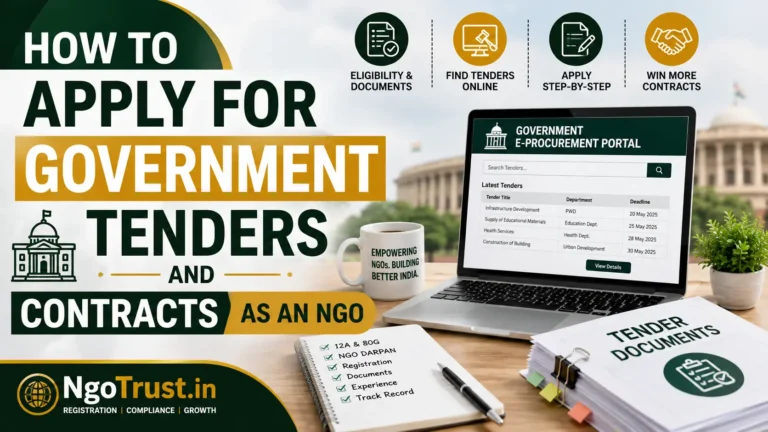
To apply for government tenders and contracts as an NGO, you first register your organisation on NGO Darpan, get PAN, 12A, 80G, and (where relevant) FCRA registration in order, then sign up on procurement portals such as GeM and the CPPP/eProcurement portal, complete document verification, and start bidding on tenders that match your area of work.
If you run an NGO, you already know that donations and CSR grants only go so far. Government tenders and contracts open up a much bigger, steadier source of funding, but the process feels confusing to most NGOs the first time around.
The good news is that applying for government tenders as an NGO is not complicated once you understand the system. This guide walks you through what government tenders are, who is eligible, and exactly how to apply, step by step.
What Are Government Tenders and Contracts?
A government tender is a formal invitation from a government department, ministry, or public sector unit asking organisations to submit a proposal for a specific piece of work, product, or service. Once a tender is awarded, it becomes a government contract.
For NGOs, this could mean anything from running a skill-training program, supplying mid-day meal ingredients, conducting a survey, managing a public health drive, or delivering welfare services on behalf of a government body.
Government departments publish these tenders on official procurement portals such as GeM (Government e-Marketplace) and the Central Public Procurement Portal (CPPP), and any eligible organisation, including registered NGOs, can apply.
Why Should NGOs Apply for Government Tenders?
Government contracts can bring real stability to an NGO’s finances and reputation. A few reasons this is worth your time:
- Steady funding: Government contracts often run for a fixed period with agreed payment terms, unlike one-time donations.
- Credibility: Working with a government department builds trust with donors, CSR partners, and the public.
- Scale: Tenders often cover large geographic areas or population groups, letting your NGO reach more people.
- Reduced dependency: Diversifying income beyond individual donors and grants makes your NGO more resilient.
Is Your NGO Eligible to Apply for Government Tenders?
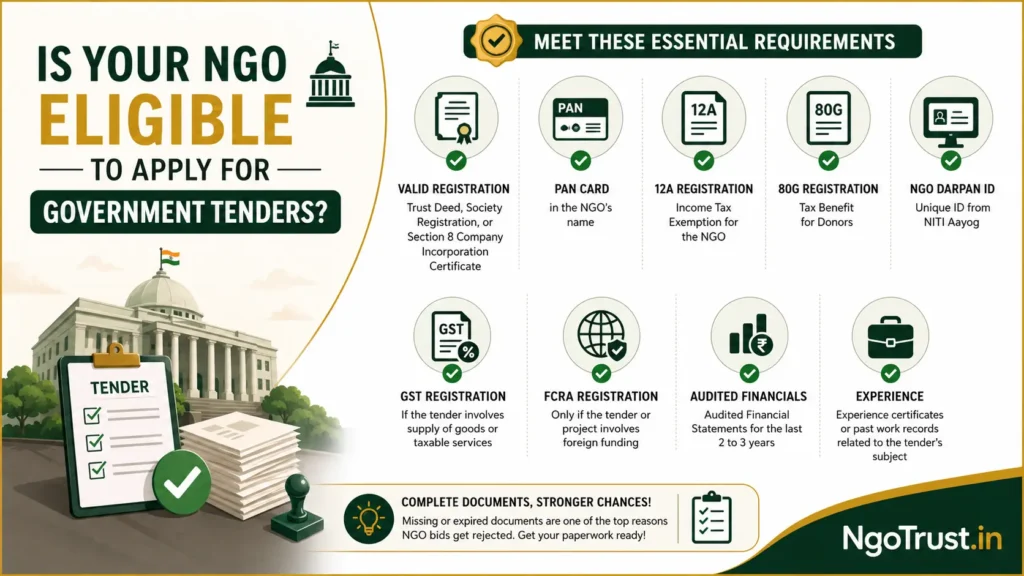
Most government departments expect an NGO to meet a basic set of legal and documentation requirements before it can bid. Eligibility generally depends on your registration type (Trust, Society, or Section 8 Company) and the specific tender’s conditions, but the common requirements include:
- Valid registration certificate (Trust deed, Society registration, or Section 8 Company incorporation certificate)
- PAN card in the NGO’s name
- 12A registration (income tax exemption for the NGO)
- 80G registration (tax benefit for donors)
- NGO Darpan unique ID from NITI Aayog
- GST registration, if the tender involves supply of goods or taxable services
- FCRA registration, only if the tender or project involves foreign funding
- Audited financial statements for the last two to three years
- Experience certificates or past work records related to the tender’s subject
If any of these documents are missing or outdated, it is worth sorting them out before you start applying, since incomplete paperwork is one of the most common reasons NGO bids get rejected.
How to Apply for Government Tenders and Contracts as an NGO: Step-by-Step
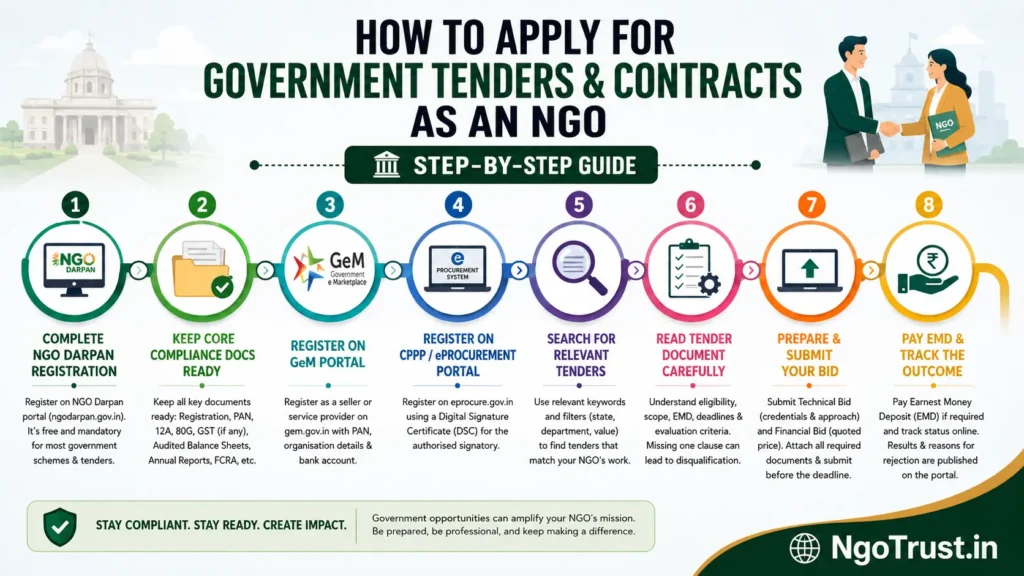
Step 1: Complete Your NGO Darpan Registration
Almost every government scheme and tender check for an NGO Darpan ID before considering an application. Registration is free and done on the NGO Darpan portal run by NITI Aayog. You will need your registration certificate, PAN, and basic organisational details to complete it.
Step 2: Keep Your Core Compliance Documents Ready
Before you touch any procurement portal, organise your documents in one folder: registration certificate, PAN, 12A and 80G certificates, GST certificate (if applicable), audited balance sheets, annual reports, and any FCRA certificate. Most portals ask you to upload these as PDFs, so scan them in advance.
Step 3: Register on GeM (Government e-Marketplace)
GeM is where most day-to-day government purchases of goods and services happen. If your NGO supplies products, training, or services that government departments buy regularly, register as a seller or service provider on gem.gov.in. You will need your PAN, organisation details, and a bank account for verification.
Step 4: Register on the CPPP / eProcurement Portal
Larger, formal tenders (especially from central ministries and state departments) are published on the Central Public Procurement Portal. Registration usually needs a Digital Signature Certificate (DSC) for the authorised signatory, so plan for this in advance since a DSC can take a few days to issue.
Step 5: Search for Relevant Tenders
Once registered, search tenders using keywords related to your NGO’s work: education, health, sanitation, women’s welfare, livelihood training, disaster relief, and so on. Filter by state, department, and tender value to shortlist ones that genuinely match your NGO’s capacity.
Step 6: Read the Tender Document Carefully
Every tender comes with a detailed document covering eligibility conditions, scope of work, submission deadline, Earnest Money Deposit (EMD), and evaluation criteria. Read this fully before applying. Missing a single eligibility clause is enough to get your bid rejected.
Step 7: Prepare and Submit Your Bid
Bids usually have two parts: a technical bid (your NGO’s credentials, experience, and proposed approach) and a financial bid (your quoted price or budget). Fill both accurately, attach every requested document, and submit before the deadline. Most portals do not accept late submissions under any circumstance.
Step 8: Pay the EMD and Track the Outcome
Many tenders require an Earnest Money Deposit, a refundable security amount that protects the department if a bidder backs out after winning. Pay this through the portal, then track the tender status online. Results, along with the reasons for rejection where applicable, are usually published on the same portal.
Common Mistakes NGOs Make When Applying for Tenders
- Applying without updated 12A, 80G, or FCRA certificates
- Missing the submission deadline because of last-minute document scanning
- Ignoring the technical eligibility criteria before submitting a financial bid
- Ignoring smaller, state-level tenders while chasing only large central ones
- Not keeping past project reports and impact data ready to prove experience
Tips to Improve Your NGO’s Chances of Winning a Government Contract
- Build a documented track record: keep annual reports, impact numbers, and testimonials organised and up to date
- Start with smaller tenders in your state before applying for large national ones
- Assign one person or a small team to track tender portals regularly, since good opportunities move fast
- Keep your compliance documents (12A, 80G, FCRA, GST) renewed well before they expire
- Get your bid documents reviewed by someone experienced with NGO compliance before submission
Frequently Asked Questions
Can any NGO apply for government tenders?
Yes, most registered NGOs (Trust, Society, or Section 8 Company) can apply for government tenders, provided they meet the specific eligibility conditions listed in that tender, such as PAN, 12A, 80G, and relevant experience.
Is FCRA registration required to apply for government tenders?
FCRA registration is only needed if the tender or project involves foreign funding. Most domestic government tenders do not require FCRA, but it is worth checking each tender document to be sure.
Which portal should an NGO use to find government tenders?
NGOs typically use GeM for goods and services procurement, and the CPPP / eProcurement portal for larger, formal tenders. State government departments and NGO Darpan also list scheme-based opportunities relevant to NGOs.
How long does NGO Darpan registration take?
NGO Darpan registration is usually processed within a few working days once your documents and details are submitted correctly on the portal.
What is an Earnest Money Deposit (EMD) in a government tender?
An EMD is a refundable security amount an NGO pays while submitting a bid. It protects the government department if the winning bidder withdraws after selection, and it is returned once the tender process is complete.
Do NGOs need a Digital Signature Certificate (DSC) to apply for tenders?
Yes, most formal tender portals such as the CPPP require a Digital Signature Certificate for the person authorised to sign and submit bids on behalf of the NGO.
Getting Your NGO Tender-Ready
Applying for government tenders as an NGO is really a matter of having the right paperwork in order, understanding each tender’s requirements, and being consistent about tracking opportunities.
None of the individual steps are difficult, but small gaps in registration or documentation are what usually hold NGOs back.
If your NGO’s 12A, 80G, FCRA, or NGO Darpan registration needs to be set up or renewed, or if you would like a second pair of eyes on a tender document before you submit it, our team at SAI NGO & Business Consultancy works with NGOs on exactly this kind of compliance and registration support.
Feel free to reach out for a consultation whenever it’s useful for you.
Useful Links
- NGO Darpan Portal
- Government e-Marketplace (GeM)
- Central Public Procurement Portal (CPPP / eProcurement)