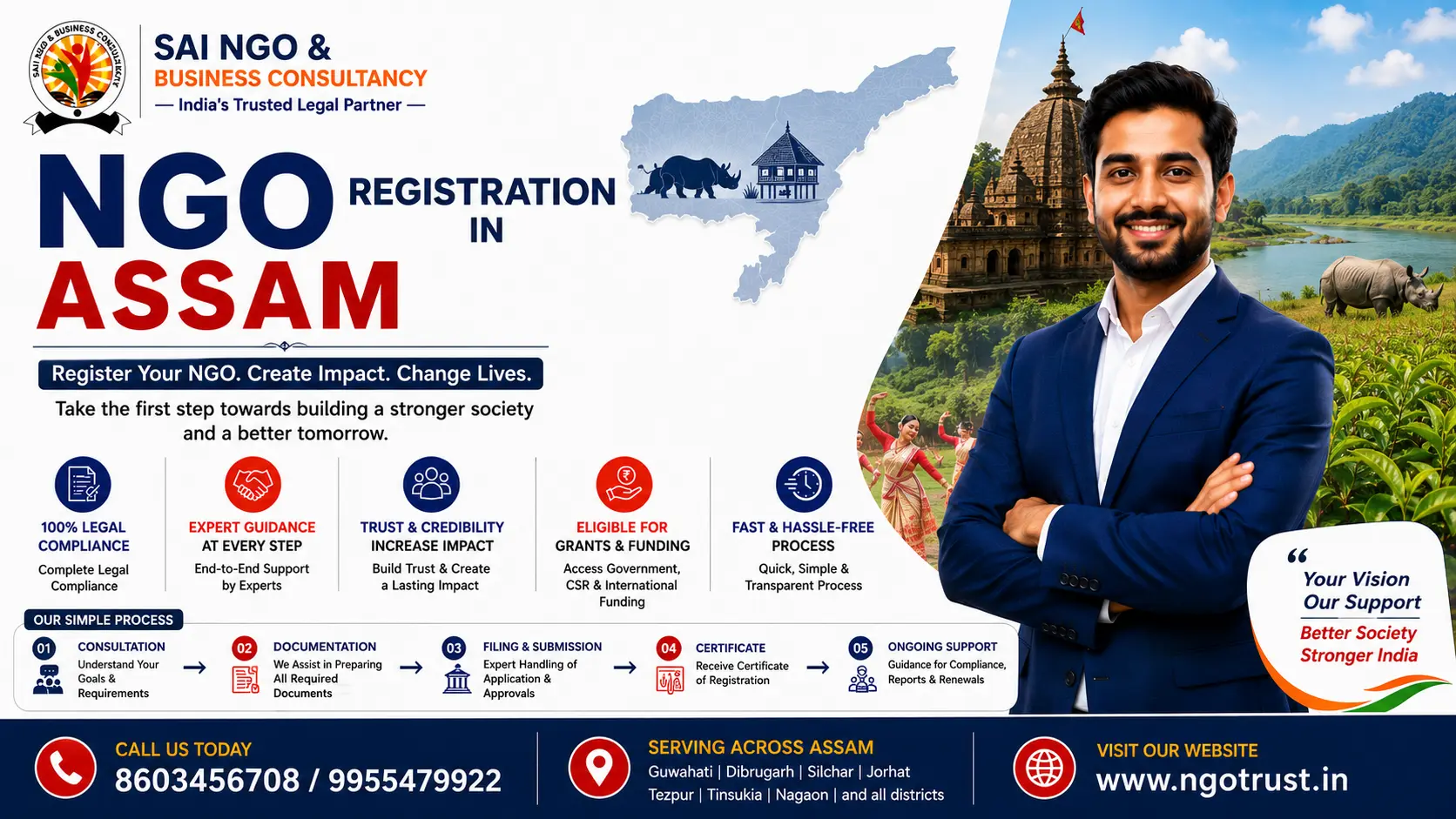
Starting an NGO in Assam is one of the most meaningful things a person can do. Whether you want to work on education in rural areas, provide healthcare to underserved communities, or protect the environment in the Northeast, the first step is always the same: legal registration.
But many people get stuck here. The paperwork feels overwhelming, the legal terms are confusing, and it is easy to make mistakes that delay the whole process by months.
This guide breaks down NGO registration in Assam in plain language. No jargon. No unnecessary complexity. Just a clear, step-by-step explanation of what you need, why it matters, and how to get it done right.
Why Is NGO Registration in Assam Important?
A registered NGO is treated as a legal entity. This matters more than most people realize.
Without registration, your organization cannot open a bank account in its own name, accept donations officially, apply for government grants, or receive FCRA approval to accept foreign funding. You also cannot apply for 12A and 80G certifications, which allow donors to claim tax exemptions and significantly increase how much people are willing to give.
Registration also builds trust. Donors, government bodies, and corporate CSR departments want to see that your organization is legitimate. A registered NGO signals credibility that an informal group simply cannot.
Who Needs to Register an NGO in Assam?
You need to register if you are:
- Starting a new organization to work on a social cause
- Running an informal group that now needs to accept donations or apply for grants
- Setting up a community-based organization in any district of Assam
- Working with international organizations and expecting foreign contributions
- Planning to hire staff and operate with a formal structure
In short, anyone who wants their social work to be taken seriously legally, financially, and administratively needs to go through the NGO registration process in Assam.
3 Types of NGO Registration in Assam
Before you file anything, you need to choose the right legal structure. This is one of the most important decisions you will make, and it affects how your NGO operates, is taxed, and is governed.
1. Society Registration Under the Societies Registration Act, 1860
This is the most common form of NGO registration in Assam. A Society requires at least 7 members and is governed by a Memorandum of Association (MoA) and a set of Rules and Regulations.
Societies are registered with the Registrar of Societies in Assam, which falls under the state government. This structure works well for educational institutions, cultural organizations, and community groups.
2. Trust Registration Under the Indian Trusts Act, 1882
A Trust is created by a Trust Deed and requires at least 2 trustees. It is often used by family-led philanthropic organizations or NGOs with a clear charitable purpose. Trusts are generally simpler to set up but offer less democratic governance compared to Societies.
3. Section 8 Company Under the Companies Act, 2013
This is the most formal and credible structure. A Section 8 Company is registered with the Ministry of Corporate Affairs (MCA) and operates much like a private company but with no profit motive. It requires at least 2 directors and 2 shareholders (who can be the same people).
Section 8 Companies are preferred by larger NGOs and those seeking FCRA registration or large institutional grants because of their transparency and regulatory requirements.
Documents Required for NGO Registration in Assam
While the exact documents vary depending on the type of registration, here is what is generally required:
For Society Registration
- Memorandum of Association (MoA)
- Rules and Regulations of the Society
- List of all founding members with addresses
- Identity proof and address proof of all members (Aadhaar, PAN, Voter ID)
- Passport-size photographs of members
- Proof of registered office address (rent agreement or ownership document)
- Cover letter addressed to the Registrar of Societies
For Trust Registration
- Trust Deed on stamp paper (value varies by state)
- Identity and address proof of all trustees
- Photographs of all trustees
- Address proof of the registered office
For Section 8 Company
- Digital Signature Certificate (DSC) for all directors
- Director Identification Number (DIN)
- Memorandum and Articles of Association
- INC-12 application form with affidavits
- Address proof and identity proof of all directors
- Utility bill or rent agreement for the registered office
All documents should be self-attested, and original copies may be required for verification in some cases.
Step-by-Step NGO Registration Process in Assam
| Step | Process | Details |
|---|
| Step 1 | Choose Your Legal Structure |
Decide whether a Society, Trust, or Section 8 Company best fits your mission, team size, and long-term goals. If you are unsure, this is a good time to speak with a legal advisor. |
| Step 2 | Draft Your Core Documents |
For a Society, draft your MoA and Rules and Regulations. For a Trust, draft the Trust Deed. For a Section 8 Company, prepare the MoA and AoA. These documents define your organization's purpose, governance structure, and operating rules, so they need to be clear and legally sound. |
| Step 3 | Collect Member/Trustee Details |
Gather identity proof, address proof, photographs, and PAN cards for all founding members, trustees, or directors. Make sure everything is consistent across documents. |
| Step 4 | Get a Registered Office Address |
Your NGO needs a physical address in Assam. This can be your own property or a rented space. You will need a utility bill and a No Objection Certificate (NOC) from the property owner if it is rented. |
| Step 5 | Submit Your Application |
For Societies: Submit the application to the Registrar of Societies, Assam (under the Department of Social Welfare).
For Trusts: The Trust Deed is executed before a Sub-Registrar or Notary.
For Section 8 Companies: File online through the
MCA portal using the SPICe+ form. |
| Step 6 | Pay the Registration Fees |
Fees vary by registration type. Society registration in Assam typically costs between Rs. 500 and Rs. 2,000 depending on the category. Section 8 Company registration fees are determined by the MCA fee structure. Stamp duty applies to Trust Deeds and varies by state norms. |
| Step 7 | Receive Your Registration Certificate |
Once approved, you will receive a Registration Certificate with a unique registration number. This is your NGO's official identity. Keep multiple copies. |
What to Do After NGO Registration in Assam
Registration is just the beginning. After you receive your certificate, here are the next steps to fully activate your NGO:
- Open a dedicated bank account in your NGO's name
- Apply for PAN card for the organization
- Apply for 12A registration to get income tax exemption for the NGO
- Apply for 80G certification so donors get tax benefits on their contributions
- Register on the NGO Darpan Portal (ngocancel.nic.in) maintained by NITI Aayog
- If you plan to receive foreign funds, apply for FCRA registration with the Ministry of Home Affairs after 3 years of operation
Common Mistakes to Avoid During NGO Registration in Assam
Many NGO founders in Assam run into the same avoidable issues. Here is what to watch out for:
- Choosing the wrong legal structure for their goals
- Drafting a vague or legally weak MoA or Trust Deed
- Mismatched names or addresses across different documents
- Missing signatures or incomplete affidavits
- Not getting a proper NOC from the property owner for the registered office
- Skipping the NGO Darpan registration after getting the certificate
These mistakes can delay your application by weeks or even force you to restart. A small investment in proper guidance upfront can save a lot of time later.
How Much Does NGO Registration in Assam Cost?
Here is a general idea of the costs involved:
- Society Registration: Rs. 500 to Rs. 2,000 (government fees) + drafting costs
- Trust Registration: Stamp duty on Trust Deed (varies) + notary or sub-registrar fees
- Section 8 Company: MCA filing fees + DSC charges + professional fees if using a CA or CS
The total out-of-pocket cost for a Society registration in Assam is usually between Rs. 3,000 and Rs. 10,000 including professional assistance. Section 8 Companies typically cost more due to the MCA filing requirements.
Need Help With NGO Registration in Assam?
Going through the registration process for the first time can feel like navigating a maze without a map. Every document needs to be exactly right, every detail needs to match, and even small errors can cause significant delays.
If you want to make sure your NGO is set up correctly from day one without spending months figuring out the paperwork yourself, speaking with a professional who handles NGO registrations regularly is often the smartest move.
A good consultant will not just file your documents. They will help you choose the right legal structure for your goals, draft legally sound governing documents, and guide you through the post-registration steps like 12A, 80G, and FCRA.
If you are ready to take the next step, feel free to reach out for a consultation. There is no pressure, no obligation, just a conversation about how to get your organization off the ground the right way.
Useful Links
All official resources mentioned in this guide: