

SAI NGO & BUSINESS CONSULTANCY
Expert services for NGO, Trust, Society Registration & Compliance across India.
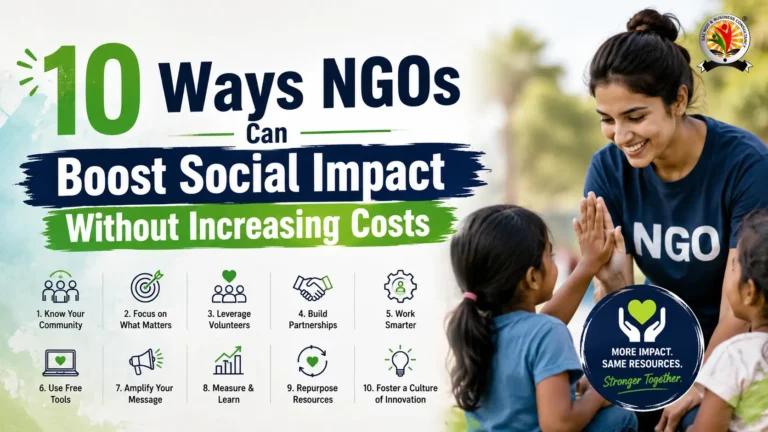
What does ‘boosting social impact without increasing costs’ mean for NGOs? It means using smarter systems, better collaboration, and available technology to deliver more value to your beneficiaries – without needing a bigger budget or more staff. It is about working efficiently, not just harder.
Running an NGO is not just about good intentions. It is about results. And many NGOs find themselves in a familiar bind: there is more work to do, more communities to serve, and more goals to hit – but the funds are not growing at the same pace.
The good news? Boosting social impact does not always require more money. In most cases, NGOs already have what they need. They just need to use it better.
This guide walks you through 10 practical, field-tested ways to increase your NGO’s social impact without stretching your budget.
1. Map Your Current Resources Before You Ask for More

Most NGOs have more resources than they realize. The problem is that those resources are scattered, underused, or invisible to the team.
Start with a simple resource audit. List out:
- Staff skills that are not being used in current programs
- Partnerships or contacts that have gone quiet
- Equipment, spaces, or materials sitting idle
- Data that has been collected but never properly analyzed
When you know what you already have, you stop duplicating work and start leveraging it. Organizations that do regular internal audits often find they can serve 15 to 20% more people with zero additional cost, simply by reallocating what exists.
2. Build Stronger Volunteer Systems
Volunteers are among the most underutilized assets in the NGO world. Many organizations recruit well but retain poorly. People come in motivated and leave feeling unheard or unvalued.
A few changes can shift this dramatically:
- Give volunteers clear roles with defined outcomes
- Match their skills to the right tasks, not just the most urgent ones
- Check in regularly and recognize their contributions publicly
- Create a simple feedback loop so volunteers feel heard
Platforms like VolunteerMatch or iVolunteer India can help you find skilled volunteers who bring professional expertise at no cost. Pro bono lawyers, accountants, marketers, and tech professionals can add enormous value to your programs.
When volunteers feel genuinely useful, they stay longer, work harder, and bring others in.
A well-structured volunteer program can deliver the equivalent of 2 to 3 full-time staff members – without adding a single paycheck to your monthly expenses.
3. Use Free and Low-Cost Digital Tools
Technology has leveled the playing field for nonprofits. There are now dozens of powerful, free or deeply discounted tools built specifically for NGOs.
Some of the most impactful ones:
- Google for Nonprofits: free Google Workspace (email, Drive, Meet, Forms)
- Canva for Nonprofits: professional design tools at no cost
- Mailchimp: free email marketing for small lists
- Trello or Asana: free project management for teams
- Kobo Toolbox: free mobile data collection for field teams
Switching to these tools does not just save money. It saves time, reduces errors, and allows smaller teams to do work that previously required large departments. If your NGO has not already applied for Google for Nonprofits, that alone is worth several hours of your week.
4. Focus on Your Core Programs, Not Everything
One of the most common ways NGOs dilute their impact is by saying yes to too many things. A new grant comes in and suddenly the organization is running a nutrition program, a livelihood program, and a digital literacy program, all at once, with the same small team.
Program sprawl is one of the silent killers of social impact.
Instead, identify the one or two programs where your NGO creates the most measurable change. Then:
- Go deeper into those programs
- Refine your methods and improve outcomes
- Let other organizations do what they do best
Focused NGOs consistently outperform scattered ones. Depth of impact beats breadth every time.
5. Partner with Other Organizations
No NGO operates in isolation, but many still behave as if they do. Collaboration between NGOs working in the same space is one of the fastest ways to increase social impact without spending more.
Consider these partnership models:
- Shared service agreements: two NGOs share an accountant, lawyer, or IT person
- Program tie-ins: one NGO provides healthcare, another provides livelihood support to the same community
- Joint grant applications: applying together often increases credibility and reach
- Knowledge sharing: hosting open workshops where multiple organizations share data and learnings
Platforms like India Development Review or GuideStar India can help you identify organizations working in the same region or thematic area.
Partnerships do not reduce your impact. They multiply it. The right collaboration can double your reach without doubling your costs.
6. Invest in Measuring What Actually Matters
If you are not measuring your impact, you are running blind. And if you are measuring the wrong things, you are running in the wrong direction.
Many NGOs track outputs (number of people trained, meals distributed, schools built) but not outcomes (did those people get jobs, did families eat better, did students improve).
Shifting to outcome measurement does three things:
- It shows you where your programs are actually working
- It helps you stop wasting resources on things that are not working
- It gives donors exactly the data they want to see
Simple tools like Theory of Change frameworks and outcome mapping can help you build a clear picture of your impact without expensive consultants. Resources from organizations like BetterEvaluation are freely available online.
7. Train Your Team in Low-Cost, High-Value Skills
Staff capacity is often the biggest limit on NGO impact. But sending people to expensive workshops is not the only way to build skills.
Some of the most effective learning comes from:
- Free online courses on Coursera, edX, or NPTEL for nonprofit management, data analysis, and communications
- Peer learning circles where team members teach each other
- Learning from partner organizations
- Inviting local experts for informal sessions
A team that knows how to write strong proposals, analyze field data, or communicate impact effectively will bring in more funding and do better work. That investment in learning pays back many times over.
8. Communicate Your Impact More Effectively
You may be doing excellent work. But if donors, government bodies, and communities do not know about it, your impact stays invisible.
Good communication does not require a marketing budget. It requires clarity and consistency.
Build a simple communication habit:
- Share one real story from the field every week on social media
- Send a short monthly email update to your donor list
- Create a one-page impact summary for every program, updated quarterly
- Train field staff to document stories using their phones
When people can see your impact, they trust you more. That trust brings in volunteers, in-kind donations, and yes, more funding.
Visibility is not vanity. It is accountability. Sharing your work openly builds the credibility that sustains your NGO long-term.
9. Tap Into Government Schemes and CSR Funding
Many NGOs leave significant resources on the table simply because they are not aware of what is available.
The Indian government has dozens of schemes that support NGO work, from MGNREGS convergence to state welfare board partnerships. And since the 2014 CSR mandate, Indian companies are required to spend 2% of net profit on social causes, directing thousands of crores to NGOs every year.
Start by:
- Registering on the NGO Darpan portal if you have not already
- Identifying CSR-eligible companies in your area through the MCA21 database
- Reaching out to District Collector offices about convergence opportunities
- Checking state government portals for welfare board registration
These are not shortcuts. They are legitimate, underutilized channels that can increase your resource base significantly.
10. Build a Culture of Continuous Improvement
The NGOs that sustain and grow their impact over decades are the ones with a culture of learning. They review, reflect, adjust, and improve as a regular habit.
This does not require a big process. It requires consistency.
Try building in:
- A brief monthly team review: what worked, what did not, what to change
- After-action reviews at the end of every major program cycle
- An annual beneficiary feedback survey, even a simple one
- Time to read sector research and apply learnings
When your team knows that improvement is expected and celebrated, not punished, they bring better ideas, catch problems early, and build the kind of programs that actually change lives.
Quick Reference: 10 Impact Strategies at a Glance
| # | Strategy | Key Action |
|---|---|---|
| 1 | Resource Audit | List unused assets, skills, and contacts. |
| 2 | Volunteer Systems | Match skills to roles and retain volunteers actively. |
| 3 | Free Digital Tools | Apply for Google for Nonprofits and use Canva. |
| 4 | Focus Programs | Go deep on 1–2 focus areas and avoid program sprawl. |
| 5 | Partnerships | Share services and co-apply for grants. |
| 6 | Outcome Measurement | Track change and results, not just activities. |
| 7 | Team Training | Use free courses and encourage peer learning. |
| 8 | Impact Communication | Share stories regularly to build trust and engagement. |
| 9 | CSR & Government | Register on NGO Darpan and map potential CSR funding sources. |
| 10 | Culture of Learning | Conduct monthly reviews, gather feedback, and drive continuous improvement. |
Need a Sounding Board? If your NGO is at a crossroads – whether it is deciding which programs to continue, figuring out how to structure your team, or making sense of compliance requirements – sometimes a short conversation with someone who knows the sector can save months of guesswork. We work with NGOs across India to help them operate smarter, stay compliant, and grow their impact sustainably. If you would like to talk through your specific situation, we are happy to listen.
Frequently Asked Questions
How can an NGO increase its social impact without more funding?
By focusing on smarter use of existing resources: auditing underused assets, building structured volunteer programs, using free digital tools, and partnering with other organizations. Most NGOs already have the capacity to serve more people. The key is organizing what exists more effectively.
What free tools are available for NGO management?
Several platforms offer free or heavily discounted plans for nonprofits. Google for Nonprofits provides free access to Google Workspace. Canva for Nonprofits gives access to premium design tools. Kobo Toolbox is free for field data collection. Mailchimp offers a free tier for email communication. Trello and Asana both have free plans suitable for small teams.
Why do NGOs struggle to scale their impact?
The most common reasons are program sprawl (doing too many things at once), weak volunteer systems, lack of outcome data, and poor communication of impact. Scaling impact does not always need more money. It needs better systems, clearer focus, and consistent measurement.
How important is outcome measurement for NGO social impact?
It is critical. Without outcome data, NGOs cannot tell whether their programs are working, which areas need improvement, or what results they are actually delivering. Donors increasingly expect outcome evidence. Tools like Theory of Change and outcome mapping help NGOs build this without large budgets.
How can NGOs access CSR funding in India?
Start by registering on the NGO Darpan portal and ensuring 12A and 80G certifications are in place. Then identify CSR-eligible companies in your area using the MCA21 database. Send targeted outreach with clear impact data. Many companies prefer NGOs with strong measurement systems and transparent reporting.
What is the role of partnerships in boosting NGO impact?
Partnerships allow NGOs to share costs, combine expertise, and serve communities more comprehensively. Shared service agreements, joint grant applications, and program tie-ins are all practical partnership models. The key is choosing partners whose work genuinely complements yours, not just any available organization.
Useful Links
Resources mentioned in this post:
| Resource | Purpose | Website |
|---|---|---|
| Google for Nonprofits | Free tools, Google Workspace, and advertising support for eligible nonprofits. | Visit Website |
| Canva for Nonprofits | Free premium design tools for nonprofit organizations. | Visit Website |
| VolunteerMatch | Volunteer recruitment and engagement platform. | Visit Website |
| iVolunteer India | Connects NGOs with volunteers across India. | Visit Website |
| Kobo Toolbox | Free data collection and survey management platform. | Visit Website |
| BetterEvaluation | Resources and tools for impact measurement and evaluation. | Visit Website |
| India Development Review (IDR) | Insights, research, and stories from India’s social sector. | Visit Website |
| GuideStar India | NGO directory and nonprofit transparency platform. | Visit Website |
| NGO Darpan Portal | Government of India portal for NGO registration and visibility. | Visit Website |
| MCA21 Database | Research CSR spending and company compliance information. | Visit Website |
| Coursera | Free and paid online courses for skill development. | Visit Website |
| edX | Online learning platform offering university-level courses. | Visit Website |
| NPTEL | Free online courses from leading Indian institutions. | Visit Website |
| Mailchimp | Email marketing and audience engagement platform. | Visit Website |
| Trello | Free project management and team collaboration tool. | Visit Website |




Impact is not just about funding—it’s about efficiency, innovation, and community engagement. These 10 tips are valuable for any NGO looking to achieve more with existing resources.